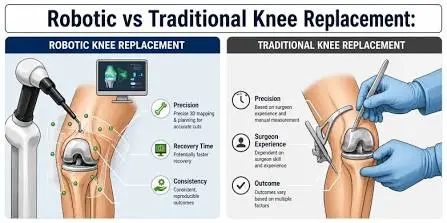
For decades, traditional Total Knee Arthroplasty (TKA) has been one of the most reliable, life-changing procedures in orthopedic medicine. However, robotic-assisted knee replacement (using systems like Mako, ROSA, or NAVIO) has rapidly grown in popularity.
A common misconception is that a robot independently operates on the patient. In reality, the orthopedic surgeon performs 100% of the operation; the robotic platform acts as a high-precision digital guide, combining 3D preoperative imaging with real-time haptic boundaries to assist with bone cuts, implant sizing, and soft-tissue balance.
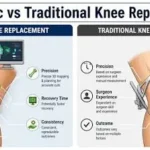
Evaluating robotic versus conventional surgery requires a clear comparison of technical differences, recovery milestones, procedural risks, and financial impacts.
1. Core Technical Differences
| Feature | Traditional Manual Surgery | Robotic-Assisted Surgery |
| Surgical Planning | Standard 2D X-rays; alignment decided largely intraoperatively by eye and manual jigs. | 3D CT-based model or intraoperative optical mapping creating a patient-specific plan. |
| Alignment Precision | Uses mechanical cutting blocks and intramedullary rods; component variance typically within 3°–5°. | Uses a robotic arm with haptic feedback; component alignment accurate to sub-millimeter and within 1°–2°. |
| Soft-Tissue Balancing | Manual ligament tensioning via surgeon’s tactile feel and visual inspection. | Real-time digital sensors measure tension across the entire arc of motion before cuts are finalized. |
| Surgeon Dependency | Highly dependent on manual dexterity and extensive surgeon volume. | Augmented by digital navigation, minimizing outlier alignments and human cut errors. |
2. Recovery Timeline Comparison
While long-term joint function at 12 months tends to converge between both approaches, robotic-assisted patients often report a gentler early-phase rehabilitation due to reduced surgical trauma and preservation of healthy periarticular tissue.
Day of Surgery to Week 1
- Robotic: Most patients stand and walk with a walker within 3 to 6 hours post-op. Outpatient (same-day) or 23-hour discharge is increasingly common for eligible candidates. Patients generally report lower immediate post-op pain scores, needing fewer narcotic pain medications.
- Traditional: Mobilization occurs on Day 1. Hospital stay typically ranges from 1 to 3 days to manage swelling and initiate physical therapy.
Weeks 2 to 6: Functional Rebuilding
- Robotic: Faster reduction in soft-tissue swelling allows patients to transition off assistive devices (canes/crutches) sooner, typically around weeks 2 to 3. Driving and sedentary desk work can often resume by weeks 3 to 4.
- Traditional: Crutches or a walker are commonly used through weeks 3 to 4. Normal daily routines and driving generally resume between weeks 4 and 6 as inflammation settles.
Months 3 to 12: Long-Term Milestones
- Both Procedures: By 6 to 12 months, clinical range-of-motion (typically 115°–125° flexion) and walking distances are virtually identical in hands of an experienced surgeon. However, robotic patients frequently report that the joint feels more “natural” during early sports activities (cycling, golf, light hiking), attributed to precise soft-tissue tensioning.
3. Risks and Complications
Every total joint replacement carries inherent surgical risks, but robotic technology alters the risk profile in specific ways.
Shared Surgical Risks
- Deep vein thrombosis (DVT) / pulmonary embolism (PE)
- Periprosthetic joint infection (PJI)
- Stiffness / arthrofibrosis requiring manipulation under anesthesia (MUA)
- Persistent post-surgical nerve pain or numbness around the incision
Robotic-Specific Risks
- Pin-Site Complications: Robotic tracking arrays require temporary optical tracker pins anchored into the femur and tibia. These introduce minor risks of pin-site infection or stress fractures at the drill sites.
- Longer Operating Room Time: Calibrating sensors, registering bone landmarks, and robotic setup can add 15 to 30 minutes to operative time, particularly during a surgical team’s early learning curve. Prolonged anesthesia can slightly increase infection vulnerability if not tightly managed.
- System Failures: Rare software glitches or optical camera line-of-sight obstructions can occur. However, surgeons can transition immediately to traditional manual instruments without compromising the surgery.
Advantages in Risk Mitigation
Because robotic instruments operate within predetermined haptic boundaries (the cutting tool stops automatically if moved outside the designated zone), there is significantly less risk of accidental damage to the posterior cruciate ligament (PCL), collateral ligaments, popliteal vessels, or surrounding nerves.
4. Procedure Costs & Insurance Coverage
Robotic knee replacement carries a price premium due to high capital equipment acquisition ($700,000 to $1.2 million per platform), maintenance contracts, single-use proprietary consumables, and specialized preoperative 3D imaging.
Cost Breakdown
- United States:
- Traditional TKA: $25,000 – $45,000 (billed facility/surgeon cost)
- Robotic TKA: $30,000 – $55,000 (typically $2,500 – $7,000 higher in out-of-pocket facility/technology fees)
- India:
- Traditional TKA (Single Knee): ₹1,80,000 – ₹3,20,000
- Robotic TKA (Single Knee): ₹2,80,000 – ₹4,50,000 (often an additional ₹50,000 to ₹1,00,000 per joint)
Insurance Considerations
- Medicare & Commercial US Payers: Inpatient and outpatient joint replacement is covered under standard CPT codes (e.g., CPT 27447) regardless of whether robotic assistance is utilized. Insurers generally do not pay an extra reimbursement code for the robot itself; the hospital absorbs or negotiates the facility fee. However, some plans may decline coverage for the preoperative planning CT scan if not deemed medically necessary.
- Prior Authorization: Always verify whether your policy classifies the specific robotic protocol as standard care or experimental/ancillary, and confirm that the facility’s advanced technology fee is capped under your in-network agreement.
Which Approach Should You Choose?
- Consider Robotic Surgery if: You have complex post-traumatic anatomy, previous hardware in the femur/tibia, severe varus/valgus deformities, are seeking a partial (unicompartmental) knee replacement (where robotic precision dramatically reduces revision rates), or prioritize a faster return to work during the first 6 weeks.
- Consider Traditional Surgery if: You are prioritizing cost control, have straightforward primary osteoarthritis, lack local access to high-volume robotic centers, or are working with an orthopedic surgeon who has performed thousands of successful manual replacements.
The single most decisive factor in joint replacement longevity remains the expertise and case volume of your orthopedic surgeon, not the brand of the tool in their hands.