Cosmetic surgery has become more accessible and socially normalized than ever before, but it remains serious, invasive medical care. Driven by viral social media transformations, heavy digital discounting, and predatory medical tourism packages, thousands of patients undergo procedures every year at facilities that cut dangerous corners on sterility, surgical training, and life-saving anesthesia protocols.
Choosing a clinic is not an aesthetic shopping decision; it is a clinical safety assessment. To protect yourself from life-threatening surgical complications, you must understand how to verify surgeon credentials, audit surgical facility accreditations, identify predatory red flags, and ensure robust emergency protocols are in place.
1. Verifying Surgeon Credentials: “Cosmetic” vs. “Plastic” Surgeon
One of the most dangerous, widespread misunderstandings in aesthetic medicine is the assumption that any doctor calling themselves a “cosmetic surgeon” has completed specialized plastic surgery training.
Legally, in many jurisdictions, any licensed medical doctor (an emergency physician, general dentist, family doctor, or gynecologist) can take a weekend seminar, purchase laser or liposuction equipment, and market themselves as a “cosmetic surgeon.”
General Medical Degree (MBBS / MD)
       ➔ Unregulated Weekend Course ➔ "Cosmetic Surgeon" (HIGH RISK)

Accredited 5–7 Year Surgical Residency + Aesthetic Fellowship
       ➔ Strict Peer-Reviewed Exam ➔ "Board-Certified Plastic Surgeon" (GOLD STANDARD)
What True Board Certification Means
- United States: Look strictly for certification by the American Board of Plastic Surgery (ABPS), which is the only plastic surgery board recognized by the American Board of Medical Specialties (ABMS). Avoid deceptive titles like “Board Certified by the American Board of Cosmetic Surgery,” which operates outside ABMS oversight.
- United Kingdom: The surgeon must be on the GMC Specialist Register for Plastic Surgery and hold membership in BAAPS (British Association of Aesthetic Plastic Surgeons) or BAPRAS.
- India: The surgeon must hold a recognized superspecialty degree: M.Ch. in Plastic and Reconstructive Surgery or DNB (Plastic Surgery) recognized by the National Medical Commission (NMC), alongside membership in APSI (Association of Plastic Surgeons of India).
The Hospital Privileges Litmus Test
Ask your prospective surgeon: “Do you hold active operating privileges to perform this exact procedure at an accredited local hospital?”
Hospitals vet surgical training and complication histories rigorously before granting operating room privileges. If a surgeon is restricted to operating only inside their private office suite because local hospitals refuse to grant them surgical privileges, do not let them operate on you.
2. Facility Accreditation: Where Is the Surgery Performed?
The operating theater where you receive anesthesia and incisions is just as critical as the surgeon holding the scalpel. A clean, modern office reception area does not guarantee an operating room equipped for emergency cardiac arrest or airway collapse.
Accrediting Bodies to Look For
Never undergo a procedure requiring general anesthesia or IV deep sedation in an unaccredited outpatient suite. Verify that the on-site surgical facility is accredited by:
- AAAASF / QUAD A (American Association for Accreditation of Ambulatory Surgery Facilities)
- AAAHC (Accreditation Association for Ambulatory Health Care)
- The Joint Commission (JCI / TJC)
- NABH (National Accreditation Board for Hospitals & Healthcare Providers in India)
Accredited facilities are legally mandated to maintain sterile positive-pressure ventilation systems, back-up emergency electrical generators, continuous biomedical equipment maintenance, and immediate access to emergency life-support drugs like dantrolene (critical for reversing malignant hyperthermia).
Who Is Administering Your Anesthesia?
A primary cause of catastrophic outcomes during cosmetic procedures (especially high-volume liposuction and tummy tucks) is improper airway and sedation management.
- The Rule: The surgeon performing your operation must never manage your anesthesia simultaneously.
- Ensure your anesthesia is administered by a dedicated, board-certified Anesthesiologist (MD/DO) or a certified professional supervised by an anesthesiologist. They should monitor your oxygen levels, end-tidal $\text{CO}_2$, heart rhythms, and blood pressure continuously while the surgeon focuses exclusively on the surgical field.
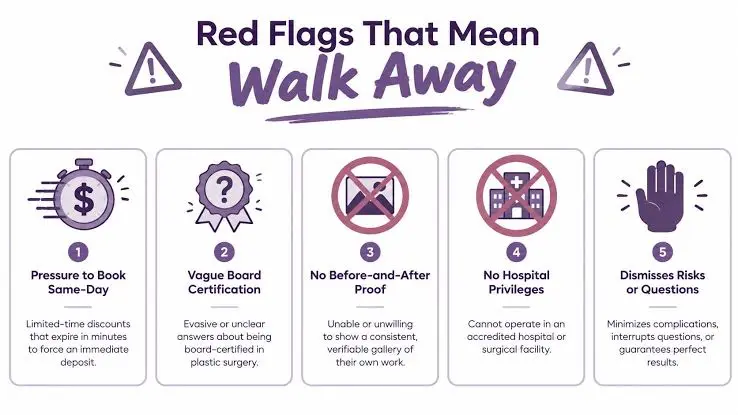
3. Major Red Flags: When to Walk Away Immediately
During your consultations, watch out for these predatory sales tactics and safety compromises:
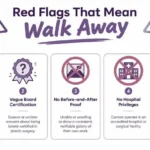
| Red Flag | The Hidden Danger | Safe Alternative Standard |
| High-Pressure Sales & Expiring Discounts | “Book by Friday for 20% off” or limited-time flash sales treat surgical procedures like retail sales, rushing your medical evaluation. | Reputable surgical clinics encourage a 2- to 3-week cooling-off period before scheduling. |
| Consultation Led Only by a “Patient Coordinator” | Meeting only a sales consultant or nurse until the day of surgery means your surgical plan was determined by a salesperson. | The actual operating surgeon must perform your comprehensive clinical exam and take your history. |
| Promises of “Zero Downtime” & “Scarless Results” | Invasive surgery always produces scarring and demands physiological recovery time. Minimizing this misleads expectations. | Honest disclosure of incision placement, long-term scarring, and realistic recovery timelines. |
| No In-Depth Medical Screening | Failing to review your family history, past anesthesia reactions, bleeding tendencies, or BMI limits before clearing you for the OR. | Mandatory pre-op lab work, EKG screening, and clearance from your primary care physician. |
| Refusal to Disclose Revision Policies | Refusing to provide written terms regarding financial responsibilities if a complication or aesthetic asymmetry occurs. | Clear, written policies outlining surgical facility and revision fee coverage in the first 12 months. |
4. Emergency Protocols and Post-Operative Safety
Complications can arise even under the care of the most skilled surgeons. A clinic’s emergency preparedness separates minor incidents from fatal outcomes.
- Hospital Transfer Agreement: Ask whether the clinic has an active, written transfer agreement with a fully equipped tertiary hospital located within 15 to 20 minutes of the facility. If a severe vascular injury, uncontrolled hemorrhage, or anesthesia crisis occurs, how will emergency medical services (EMS) safely transport you?
- Post-Operative Monitoring & On-Call Availability: Clarify where you will recover during the first 24 to 48 hours. Does the clinic have 24/7 on-call medical staff to handle fever, hematomas, or uncontrolled pain, or will you be directed to an emergency room voicemail?
- Venous Thromboembolism (VTE) Protocols: Major cosmetic procedures like abdominoplasty carry high risks of deep vein thrombosis (DVT) and pulmonary embolism (PE). Verify that the surgical team routinely utilizes sequential compression devices (SCD boots), low-molecular-weight heparin when indicated, and early mobilization protocols.
Frequently Asked Questions (FAQs)
Can a registered nurse or aesthetician perform minor surgical procedures?
No. While licensed nurses and physician associates can administer certain non-surgical injectables (such as neurotoxins or dermal fillers) under physician oversight, they cannot legally or safely perform surgical incisions, deep tissue undermining, or surgical liposuction.
What is the difference between ABPS certification and state medical licensing?
A state medical license permits a physician to legally practice general medicine within that jurisdiction, but it does not evaluate competence in a specific specialty. ABPS certification confirms that the surgeon completed at least 5 to 6 years of accredited surgical residency training, passed rigorous written and oral examinations, and is peer-reviewed specifically for plastic and reconstructive surgery.
Are before-and-after photo galleries reliable proof of surgical quality?
Photos can be helpful, but they should be viewed critically. Be cautious of photos taken with different lighting, clothing, posture, or angles between pre-op and post-op. Ask the surgeon to show you full portfolios of unedited clinical photographs, including long-term results (6 to 12 months post-op) rather than immediate OR-table pictures, which hide swelling, distortion, and mature scars.
Why is medical tourism for cosmetic surgery considered high risk?
While destination surgery clinics may advertise significantly lower prices, they introduce unique hazards: unregulated surgical facility standards, high-altitude long-haul flights immediately post-op (which substantially increases the risk of blood clots), language barriers during emergencies, and an absence of local legal recourse or post-operative continuity of care once you fly home.