Refractive surgery has evolved far beyond traditional blade-based procedures. With modern femtosecond and excimer lasers, corrective eye surgery provides safe, permanent alternatives to glasses and contact lenses.
However, there is no universal “best” laser procedure. Selecting between LASIK, PRK, and SMILE requires understanding your unique corneal anatomy, your lifestyle, and how each technique modifies the eye.
1. LASIK vs. PRK vs. SMILE: How They Differ
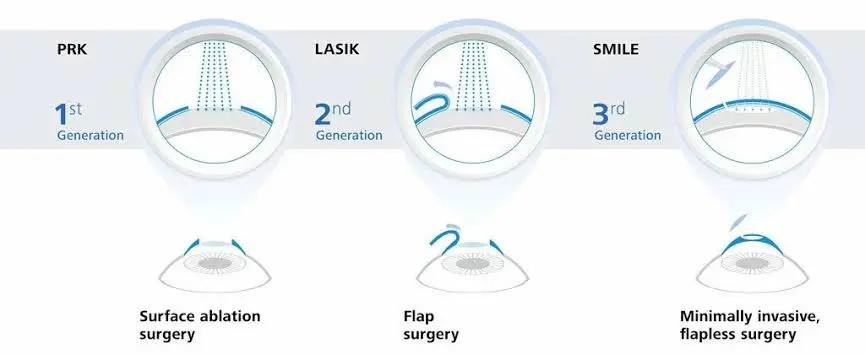
All laser refractive surgeries correct vision by permanently reshaping the cornea (the transparent dome covering the eye) so light focuses precisely on the retina. They differ fundamentally in how they access and reshape that tissue.
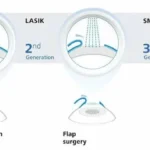
LASIK: Flap Created  ➔  Excimer Laser Reshapes Cornea  ➔  Flap Repositioned
PRK:   Surface Layer Removed  ➔  Excimer Reshaping  ➔  Epithelium Regrows Under Bandage Lens
SMILE: Femtosecond Laser Carves Lenticule  ➔  Keyhole Extraction (No Flap)
| Feature | LASIK (Femto / Bladeless) | PRK (Surface Ablation) | SMILE (Small Incision Lenticule Extraction) |
| Flap Creation | Yes (Thin hinged flap created using a femtosecond laser) | None (Epithelial surface layer gently dissolved or scraped away) | None (Small 2–4 mm keyhole incision only) |
| Laser Mechanism | Femtosecond laser + Excimer laser | Excimer laser alone | Femtosecond laser only (e.g., VisuMax) |
| Discomfort Level | Mild scratchiness for 4–6 hours | Moderate burning/grittiness for 3–5 days | Minimal to none |
| Visual Recovery | Rapid (Functional vision in 24 hours) | Gradual (1–2 weeks for functional vision; full stabilization in 1–3 months) | Fast (24–48 hours) |
| Dry Eye Risk | Moderate (temporary disruption to corneal nerves during flap cut) | Low (nerves regenerate during epithelial healing) | Lowest (corneal biomechanics and surface nerves remain mostly intact) |
| Impact Vulnerability | Flap displacement risk under direct, heavy trauma | Zero flap risk (ideal for military, boxers, contact sports) | Zero flap risk |
2. Candidacy Factors: Which Procedure Fits Your Eyes?
Before a clinic books a surgery, a patient must complete a comprehensive pre-refractive diagnostic workup.
General Baseline Criteria
- Minimum age of 18 with a stable prescription (unchanged for at least 12 months).
- Healthy ocular surface with no active infections, severe dry eye disease, cataracts, or uncontrolled glaucoma.
- Normal corneal topography without signs of keratoconus or irregular astigmatism.
- Not pregnant or nursing (hormonal fluctuations alter corneal curvature and tear production).
Procedure-Specific Suitability
- Best for PRK:
- Patients with thin corneas (<500 microns) where cutting a 100–120 micron LASIK flap would leave insufficient stromal bed tissue (<250–300 microns).
- Individuals in high-impact professions or combat sports (martial artists, police, military personnel) where a direct blow could dislodge a flap.
- Patients with minor basement membrane dystrophies.
- Best for LASIK:
- Patients with normal corneal thickness seeking the fastest possible visual recovery and minimal time away from work.
- Patients with moderate myopia, hyperopia (farsightedness), or mixed astigmatism.
- Best for SMILE:
- Patients with moderate to high myopia (-1.00D to -10.00D) with or without astigmatism.
- Individuals prone to mild or moderate dry eyes who want a flapless procedure without PRK’s multi-day recovery.
- Limitation: SMILE cannot currently treat hyperopia (farsightedness) under standard protocols; it is primarily optimized for nearsightedness and astigmatism.
3. Procedure Costs & Hidden Expenses
Refractive surgery is considered an elective procedure by most private health insurers and Medicare, meaning costs are usually paid out of pocket.
Cost Ranges (Both Eyes)
- United States:
- PRK: $3,500 – $5,000
- Custom/Femto-LASIK: $4,000 – $6,000
- SMILE: $4,500 – $6,500
- India:
- PRK: ₹35,000 – ₹70,000
- Bladeless / Contoura LASIK: ₹65,000 – ₹1,20,000
- SMILE / SMILE Pro: ₹1,00,000 – ₹1,60,000
Common Hidden Costs to Confirm Upfront
- Pre-Operative Diagnostics: Corneal tomography (Pentacam/Orbscan), pachymetry, and pupillometry (often billed separately at ₹2,500–₹5,000 / $150–$350).
- Post-Operative Eye Drops: Specialized antibiotic, anti-inflammatory, and preservative-free artificial tear drops needed for 1 to 3 months.
- Enhancement / Touch-Up Guarantee: Ask if the clinic includes free or subsidized re-treatments during the first 12 months if minor regression occurs.
4. How to Choose an Accredited Eye Clinic
Never choose a clinic solely on price or discount billboards. Bargain centers often rely on older microkeratome blades rather than femtosecond lasers and may cut corners on pre-operative screening.
- Accreditation Standards: Verify that the facility is accredited by recognized bodies such as the Joint Commission International (JCI), AAAHC (US), or NABH (India). Accreditation ensures strict sterility protocols in the laser suite and standardized emergency backup equipment.
- Advanced Diagnostic Platforms: Leading refractive centers do not rely on basic auto-refractors. They must have a Pentacam, Galilei, or Sirius Scheimpflug tomography system to screen for subclinical keratoconus and evaluate posterior corneal elevation.
- Independent Surgeon Track Record: Confirm that your surgeon is a fellowship-trained cornea or refractive specialist, not a general practitioner. Ask for their specific complication and enhancement rates (standard industry enhancement rates are under 3%–5%).
- Honest Exclusion Policy: A top-tier clinic turns away 15% to 25% of evaluated patients due to unsuitable corneal thickness, suspicious topography, or pupil size issues. If a clinic guarantees 100% eligibility before running corneal topography, seek care elsewhere.
Frequently Asked Questions (FAQs)
Can my vision deteriorate again after laser eye surgery?
Laser eye surgery permanently reshapes the corneal stroma. However, the natural lens inside your eye continues to age. Around age 40 to 45, almost everyone develops presbyopia (age-related loss of near focusing), requiring reading glasses regardless of whether they had LASIK, PRK, or SMILE in their 20s or 30s.
What is Contoura Vision, and how is it different from standard LASIK?
Contoura Vision is a topography-guided LASIK platform. While standard wavefront LASIK corrects general refractive error, Contoura maps up to 22,000 unique elevation points on your cornea, smoothing out micro-irregularities. It is known for reducing night glare, halos, and starbursts compared to older laser platforms.
What is the primary downside of PRK compared to LASIK?
Recovery time and discomfort. Because the epithelial surface layer must completely regenerate, patients typically experience mild to moderate discomfort for 3 to 4 days and may require 7 to 10 days away from screen-heavy work before functional clarity returns. In contrast, LASIK and SMILE patients frequently return to work within 24 to 48 hours.
Can I undergo laser eye surgery if I have astigmatism?
Yes. Modern wavefront and topography-guided LASIK, PRK, and SMILE routinely correct astigmatism alongside myopia or hyperopia. High or irregular astigmatism will be evaluated during your tomography mapping to verify adequate corneal symmetry.