Replacing a full arch of missing or failing teeth is a restorative milestone that impacts oral function, facial bone structure, and everyday quality of life. Modern implant dentistry primarily offers two paths for full-arch fixed restoration: Traditional Full Mouth Dental Implants (often utilizing 6 to 8 implants per arch with segmented bridges) and the All-on-4® Protocol (a graftless full-arch fixed bridge anchored on four strategically angled posts).
While both provide fixed, non-removable alternatives to loose dentures, they differ significantly in surgical complexity, bone grafting requirements, material options, and total cost.
1. Procedure Breakdown: Traditional vs. All-on-4
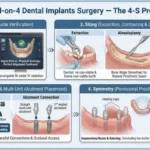
All-on-4 Protocol:
CBCT 3D Scan ➔ Extractions & 4 Tilted Implants ➔ Same-Day Immediate Provisional Bridge ➔ 4-6 Mos Osseointegration ➔ Final Permanent Prosthesis

Traditional Full Mouth:
CBCT Scan ➔ Extractions & Bone Grafting/Sinus Lift (3-6 Mos Healing) ➔ 6-8 Straight Implants Placed ➔ Healing (3-6 Mos) ➔ Segmented Permanent Bridges
The All-on-4 Protocol
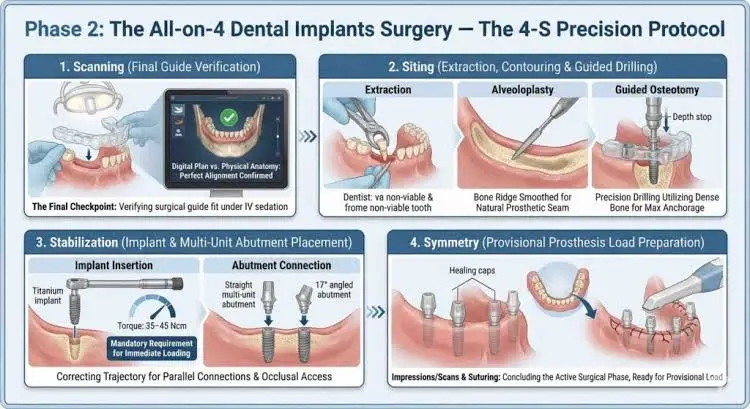
- Implant Number & Placement: Uses exactly 4 implants per arch. The two anterior implants are placed vertically, while the two posterior implants are placed at angles of 30° to 45°.
- Avoidance of Bone Grafts: Angling posterior implants utilizes higher-density native bone in the anterior jaw, typically bypassing the need for maxillary sinus lifts or horizontal ridge augmentations.
- Immediate Loading (“Teeth in a Day”): If insertion torque meets clinical thresholds (typically $\ge 35\text{ N}\cdot\text{cm}$), a fixed, temporary acrylic hybrid bridge is screwed onto multi-unit abutments on the day of surgery, eliminating the need for a removable healing denture.
- Treatment Timeline: 4 to 6 months total to osseointegrate and switch from provisional to the permanent bridge.
Traditional Full Mouth Implants (All-on-6 / All-on-8 / Segmented Bridges)
- Implant Number & Placement: Typically uses 6 to 8 implants in the upper jaw (maxilla) and 4 to 6 in the lower jaw (mandible), positioned vertically along the alveolar ridge.
- Bone Grafting Reliance: Because implants are placed upright into premolar and molar regions, patients with long-standing tooth loss often require extensive bone grafting or lateral window sinus lifts.
- Staged Healing: Bone grafts require 3 to 6 months of consolidation before implant placement. Implants then heal unloaded under the gums for another 3 to 6 months while the patient wears a removable provisional denture.
- Treatment Timeline: 8 to 12+ months from initial extraction/grafting to permanent crown delivery.
2. Head-to-Head Comparison
| Feature | All-on-4 Protocol | Traditional Full Mouth (6–8 Implants) |
| Number of Implants | 4 per arch | 6 to 8 per arch |
| Bone Grafting / Sinus Lift | Rarely required | Frequently required |
| Immediate Teeth Same Day | Yes (Fixed provisional bridge) | Rare (Usually removable denture during healing) |
| Surgical Invasiveness | Lower (4 osteotomy sites) | Higher (Multiple surgical phases & sites) |
| Chewing Force Distribution | Concentrated across 4 anchor points | Distributed evenly across 6–8 points |
| Prosthetic Failure Vulnerability | If 1 implant fails, the whole bridge fails | If 1 implant fails, remaining implants can often salvage the bridge |
| Dietary Transition | Soft diet for 6–8 weeks, normal thereafter | Strict soft diet after each staged surgical phase |
3. Prosthetic Materials: Acrylic vs. PEEK vs. Monolithic Zirconia
The implant posts anchored into your jawbone are almost universally grade 4 or grade 5 medical titanium (or occasionally biocompatible zirconia). However, the visible prosthetic bridge secured to those fixtures varies widely in durability, aesthetics, and maintenance needs:
1. Acrylic-Titanium Hybrid (Standard All-on-4 Option)
- Structure: High-grade titanium milled framework wrapped in pink acrylic gum tissue and denture-grade composite resin teeth.
- Pros: Shock-absorbent, easier on the opposing natural dentition, and relatively easy to repair chairside if a tooth chips.
- Cons: Acrylic wears down over time, can stain or harbor odors if not maintained with a water flosser, and usually requires replacement or re-lining every 7 to 10 years.
2. Monolithic Zirconia (The Gold Standard)
- Structure: A solid block of pre-shaded, multi-layered zirconium oxide custom-milled via CAD/CAM technology, with pink ceramic layering for gingival aesthetics.
- Pros: Virtually chip-proof, non-porous (will not stain or absorb odors), highly biocompatible, and provides optimal lifelike translucency.
- Cons: Rigid and unforgiving on bite forces (requires precise occlusal adjustment), significantly heavier, and costs $3,000–$6,000 more per arch.
3. PEEK / Trilor Framework with Composite Crowns
- Structure: Polyether ether ketone (PEEK) or composite-fiber framework faced with individualized composite or porcelain crowns.
- Pros: Lightweight, high tensile strength, and flexural elasticity that closely mimics natural bone, cushioning chewing forces on the implants.
- Cons: Less long-term clinical track record compared to monolithic zirconia.
4. Total Clinic Costs Breakdown
Dental implants are customized surgical procedures. Total pricing reflects diagnostic work, extractions, bone grafting, surgical fixtures, and the final lab-fabricated restoration.
Cost Comparison (United States)
- All-on-4 (Per Arch):$15,000 to $30,000
- With standard Acrylic Hybrid: $15,000 – $22,000
- Upgraded to Monolithic Zirconia: $24,000 – $30,000+
- Full Mouth All-on-4 (Both Arches):$30,000 to $55,000
- Traditional Full Mouth (6–8 Implants Per Arch):$28,000 to $45,000 per arch ($55,000 – $90,000 for both arches) due to added bone grafting, extra surgical fixtures, and individual ceramic bridge units.
Cost Comparison (India)
- All-on-4 (Per Arch):₹1,80,000 to ₹3,50,000 (depends on implant brand: Osstem/Dentium vs. Nobel Biocare/Straumann).
- Traditional Full Arch (6–8 Implants):₹2,80,000 to ₹5,00,000+ per arch (including sinus lifts and bone grafts).
Common Itemized Line Items to Review
- Pre-Operative 3D CBCT Scan & Virtual Surgical Guide: $300 – $1,000 / ₹3,000 – ₹8,000.
- Extractions & Alveoloplasty (Bone Smoothing): $150 – $400 per remaining tooth.
- Bone Grafting / Membrane / Sinus Lift: $800 – $3,000 per quadrant (often bypassed with All-on-4).
- Immediate Provisional Prosthesis: Often included in All-on-4 packages, but verify whether the final zirconia prosthesis carries an extra laboratory upgrade fee.
Frequently Asked Questions (FAQs)
What happens if an implant fails in an All-on-4 setup?
Because all four implants share the mechanical load of an entire 10-to-12-tooth bridge, the loss of one implant means the bridge loses its structural foundation. The bridge must usually be removed, the failed site grafted and healed, and a replacement implant (or conversion to an All-on-5/All-on-6) completed before reattaching a permanent arch.
Does All-on-4 feel like natural teeth?
Yes, but with slight differences. The biting power of an implant bridge restores roughly 85% to 95% of natural chewing force (compared to only 20% to 25% with traditional removable dentures). Because implants lack the periodontal ligament of natural teeth, you lose micro-sensory feedback (proprioception), but you regain full stability without slippage, roof-of-the-mouth palatal coverage, or speech interference.
Can I clean under an All-on-4 bridge?
Yes, and daily maintenance is critical. The bridge is permanently fixed to the implants, so you cannot remove it at home. Cleaning requires using a water flosser (oral irrigator), superfloss with stiff threaders, and specialized interdental brushes to clear debris from the narrow gap between the bridge and the gumline to prevent peri-implantitis. Your dentist will unscrew and deep-clean the prosthesis during annual maintenance visits.
How do I know if I need All-on-4 vs. All-on-6?
The decision is dictated by bone volume and jaw size. If you have broad dental arches, a heavy bite, dense bone quality, or are prone to bruxism (teeth grinding), adding two additional posterior implants (All-on-6) significantly improves load distribution and provides structural redundancy. If bone height in the posterior jaw is severely depleted, All-on-4 is often the preferred, graft-free surgical solution.