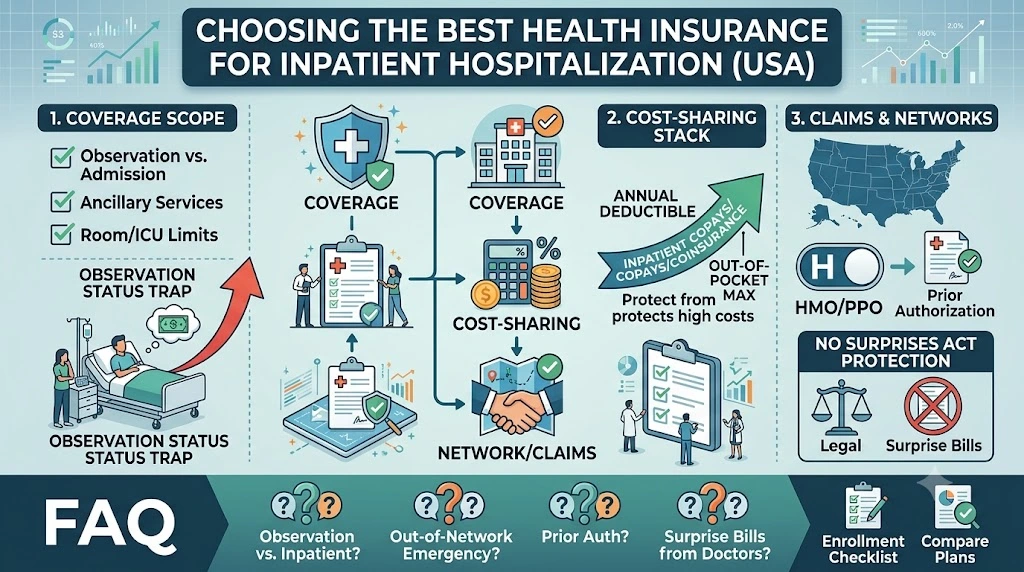
A single unexpected hospital admission in the United States can quickly generate tens of thousands of dollars in medical debt. While standard outpatient doctor visits require manageable flat fees, inpatient hospitalization—where a physician formally admits you to an acute care bed—activates an entirely different layer of complex billing mechanics.
Navigating healthcare exchanges, employer plans, or private insurance requires looking past attractive monthly premiums. To protect your household finances against catastrophic hospital bills, you must understand how coverage structures, cost-sharing (deductibles, copays, and coinsurance), and network claim settlements function together.
1. What Inpatient Coverage Actually Covers (and Misses)
Under the Affordable Care Act (ACA), inpatient hospital services are an Essential Health Benefit (EHB). That means qualifying plans cannot place annual or lifetime dollar caps on covered inpatient care. However, coverage scope is defined by medical necessity and administrative fine print:
- Observation Status vs. Formal Inpatient Admission: This is one of the costliest traps in US healthcare. A doctor may place you in a hospital bed for 24 to 48 hours under “Observation Status” to monitor your symptoms. Legally, observation is billed under outpatient benefits (Part B in Medicare or outpatient cost-sharing in commercial plans), not inpatient care. This shift can expose you to multiple facility fees, separate specialist bills, and loss of skilled nursing facility (SNF) coverage post-discharge. Always ask the attending physician: “Am I formally admitted as an inpatient?”
- Room, Board & Intensive Care (ICU): Standard inpatient coverage pays for a semi-private room, nursing staff, monitoring, and round-the-clock intensive care. Private rooms are rarely covered unless medically necessary (e.g., severe contagious infection or strict isolation protocols).
- Ancillary Hospital Services: Major hospital bills consist primarily of operating room fees, surgical supplies, anesthesia, specialized medical devices, pathology, and pharmacy charges administered during your stay. Verify whether expensive specialty drugs administered in-hospital require prior authorization.
2. Navigating the Cost-Sharing Stack: Deductibles, Copays, and Coinsurance
In the US system, copay is only one component of out-of-pocket expenses. Hospital stays trigger a four-tiered cost-sharing sequence:
1. Annual Deductible ➔ 2. Inpatient Copay / Coinsurance ➔ 3. Out-of-Pocket Maximum
| Cost Element | How It Works | Hospital Stay Example ($30,000 Bill) |
| Deductible | Amount you pay 100% upfront before insurance kicks in. | You pay the first $2,500. |
| Inpatient Copay | A flat fee charged per admission or per day (e.g., $500/day up to 5 days). | Flat $500 per admission fee applied. |
| Coinsurance | A split percentage (e.g., 80/20) between insurer and patient after deductible. | Insurer pays 80% ($21,600); you pay 20% ($5,400). |
| Out-of-Pocket Max (OOPM) | The legal ceiling on what you pay for covered in-network care in a calendar year. | If your OOPM is $6,500, your total liability stops there. |
Structuring Your Policy Choices
- Copay vs. Coinsurance Plans: Plans with a flat copay for hospital stays (common in Gold and Platinum HMO plans) offer predictable expenses (e.g., “$1,000 copay per admission”). High-Deductible Health Plans (HDHPs) or Bronze/Silver plans usually charge a high deductible followed by 20% to 30% coinsurance, which quickly reaches your annual out-of-pocket maximum on an inpatient bill.
- The Real Benchmark (Out-of-Pocket Maximum): When budgeting for severe illness, your plan’s Out-of-Pocket Maximum is the single most critical figure. Once reached, the insurer pays 100% of all covered in-network services for the remainder of the benefit year.
3. “Cashless” In-Network Billing & The No Surprises Act
In the US, “cashless” claims are handled through direct provider-to-payer billing within preferred networks. You do not pay the hospital cash upfront if they are contracted with your insurer, but you must know how network types process approvals and claims:
- HMO (Health Maintenance Organization): Requires strict adherence to a regional provider network and primary care physician (PCP) referrals. Non-emergency hospitalizations outside the network are completely uncovered.
- PPO (Preferred Provider Organization): Offers flexibility to use out-of-network facilities, but at substantially higher coinsurance rates and separate out-of-network deductibles.
- Prior Authorization (Pre-Certification): For any scheduled or non-emergency inpatient admission, your physician must obtain prior authorization from the insurer demonstrating medical necessity. If unapproved, the insurer can deny payment entirely, leaving you liable for the balance.
- Protection Under the No Surprises Act: Prior to 2022, patients admitted to in-network hospitals were frequently balance-billed by out-of-network emergency physicians, anesthesiologists, or radiologists working at the facility. Under the federal No Surprises Act, balance billing for emergency inpatient services and non-emergency ancillary services at in-network facilities is illegal. Your cost-sharing must be calculated at the lower in-network rate.
4. Key Factors to Compare Before Enrolling
- Hospital System Inclusions: Check whether your region’s leading trauma centers, academic medical centers, and specialized children’s or cardiac hospitals are listed as Tier 1 preferred in-network providers.
- Pre-Admission and Discharge Continuity: Inpatient care does not end at discharge. Review coverage terms for post-acute physical therapy, home healthcare visits, and durable medical equipment (DME) like wheelchairs or surgical beds.
- HSA Eligibility: If choosing a plan with high hospital coinsurance, pair it with an employer-sponsored or individual Health Savings Account (HSA). Pre-tax contributions allow you to fund inpatient deductibles using untaxed dollars.
Frequently Asked Questions (FAQs)
What is the difference between observation status and an inpatient stay?
Observation care is considered an outpatient service used by doctors to determine whether an admission is clinically necessary. Even if you spend two nights in a hospital bed, observation status can trigger outpatient copays and coinsurance for individual tests, and it does not count toward Medicare’s 3-day inpatient stay rule for skilled nursing facility coverage.
What happens if I am admitted to an out-of-network hospital during an emergency?
Under the federal No Surprises Act, emergency services must be covered by your insurance without prior authorization, regardless of whether the hospital is in-network. The insurer cannot charge you higher cost-sharing (copays or coinsurance) than what you would pay at an in-network facility.
How does prior authorization work for non-emergency inpatient procedures?
For elective surgeries or planned medical treatments requiring a hospital stay, your surgeon’s office submits clinical notes and diagnostic evidence to your insurer days or weeks in advance. The insurer reviews the request against clinical guidelines and issues an authorization number. Never undergo a planned hospital admission without confirming that your pre-certification has been approved in writing.
Can an in-network hospital still issue surprise bills from out-of-network doctors?
Federal law prohibits out-of-network providers (such as emergency room doctors, anesthesiologists, pathologists, and radiologists) from balance-billing you if you received care at an in-network facility. You are only responsible for your standard in-network cost-sharing amounts for those services.